
If you've been around the safety world for any amount of time, you've seen the hierarchy of controls graphic more than once. It's a great tool, helping organizations find the most effective forms of control for a hazard.
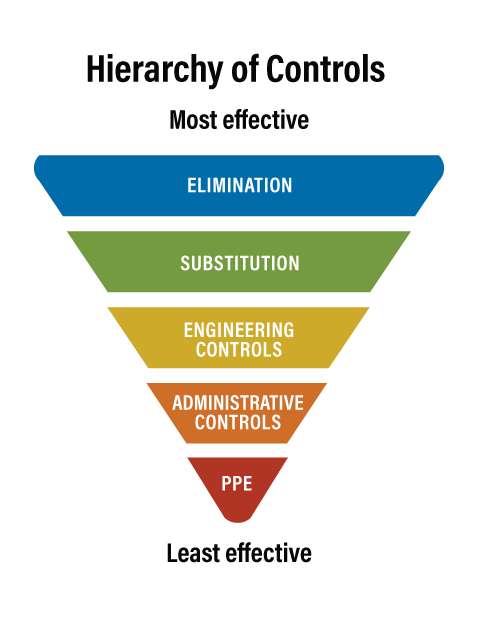
But one point that doesn't seem to be discussed enough is that it's possible to combine controls together to reduce risk to an acceptable level, rather than relying solely on one control near the top.
Sometimes it is just not possible or at all feasible to eliminate the hazard, and there aren't any viable substitutions. That can cause some hand-wringing and considering whether what we're doing is enough. Will employees be safe enough with the controls available to us?
This is where you can start to put on your thinking cap to see what pieces are left to create a robust enough controls system to keep employees safe. Can you combine an engineering control along with OSHA-compliant PPE? Are there several different administrative controls you can consider using at the same time: maybe work rotation in the heat along with scheduled breaks throughout the day.
While no combination of lower level controls is going to equate eliminating a hazard, you can put together a few different types of controls that equal a robust program that reduces risks well below what is already required by OSHA.
So our challenge to you is to not give up if you don't have access to those higher level controls at the top of the pyramid. Get a group together to problem solve and see how much risk you can get rid of by combining several controls at the lower end.
